
100 Matches: Alhamarsheh on the Verge of a Historic Achievement with Jordan
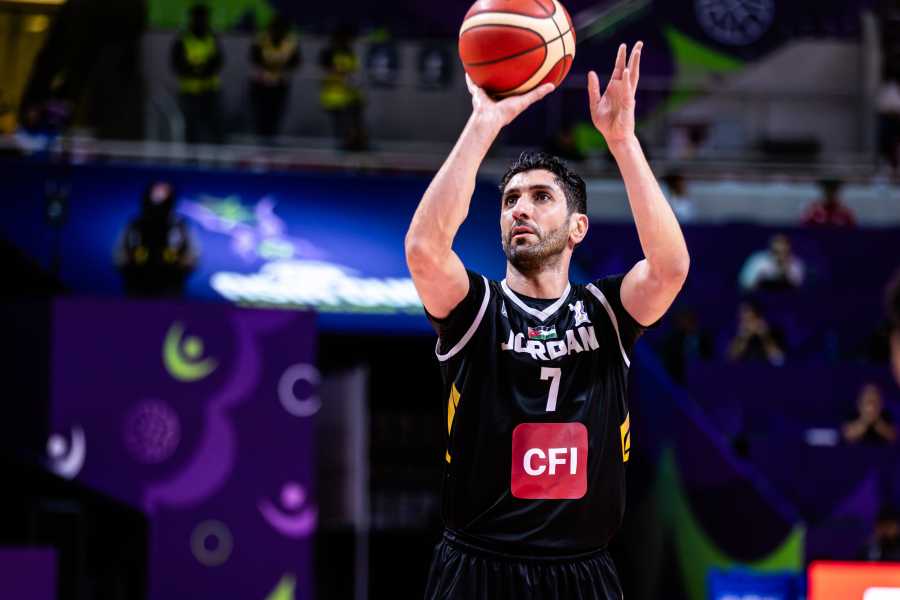
Amman, October 24 — Somewhere on the school fields of Jerash, a young boy wearing his school team’s jersey once dreamed of representing Jordan one day. Little did Ahmad Alhamarsheh know that this simple dream would lead him to become one of the most capped players in the history of the national basketball team — now standing on the verge of his 100th appearance, a milestone he may reach by the end of November in the opening game of the Asian Qualifiers for the 2027 FIFA World Cup against Syria.
With a proud smile, Alhamarsheh — the guest of the second episode of Salwiya Story — says: "Reaching 100 games with the national team is an honor, pride, and privilege. Whether I played one match or a thousand, the honor remains the same… representing my country."
For him, the number 100 is not an endpoint, but a continuation of the legacy of those who came before him and those who will carry it forward. He knows that every match he played was a link in a long chain of sacrifice and dedication — and that this centennial mark is only a symbol of a journey filled with sweat and determination.
As Alhamarsheh looks back, emotions flood his heart: "It’s a mix of feelings — the importance of national team games and the dream of a kid who once played for his school team, now standing so close to his 100th game wearing the national jersey."
He never imagined reaching that number when he began his career. His goal was simpler — just to be part of the national team and contribute to it. "Thank God… we managed to reach this point," he says.
He recalls a pivotal moment that changed his path — participating in the 2010 Asian Games with the senior national team, where he first felt he had truly become one of its pillars.
The road was never easy. Every achievement has its price, and every stop comes with its challenges. Alhamarsheh recalls one of his toughest moments: "My injury during the last window of the World Cup qualifiers, before facing New Zealand and China, was the hardest. I suffered ligament tears and a knee injury. With clubs, the pressure is less because the season is long, but injuries with the national team always hurt more."
Despite it all, retirement was never on his mind. "No, especially not with the national team," he says. "As long as I’m healthy and fit, I’ll give everything I have. Basketball is my career and my life, and I can still give more."
When asked about handling pressure and criticism, he smiles confidently: "At first, when I was less experienced, criticism used to bother me. But now, I see pressure as something positive. I know myself — I’m ready and prepared — and every challenge is an opportunity to prove myself."
Asked about a moment that changed his career, he answers humbly, with awareness of his responsibilities: "There isn’t a single moment that changed my path, but the responsibilities you carry — as a player and as a person — can change how you see life.
Some players treat basketball as a hobby while working elsewhere, but for me, it was and still is my whole life."
Alhamarsheh was never alone on this journey. His family in Jerash supported him from the very beginning, followed by mentors within the game. He mentions: "Wissam Al-Sous always supported me as a player, and when he became my coach, he treated me like a brother and a friend. Zaid Abbas has always been my strength, role model, and inspiration — one of the main reasons I’ve kept going. Wissam Daghles also inspires and motivates me and always gives me confidence."
Those figures taught Alhamarsheh the meaning of leadership and being a role model — how a player can become a symbol for younger generations. "I learned from Daghles, Al-Sous, and Abbas how to be a leader, how to communicate with players, and how to carry myself on and off the court," he says.
He adds: "I try to pass on motivational words to the younger players, like: ‘Stay ready. Don’t say you were treated unfairly. Life may not be fair, but your chance will come.’"
For Ahmad, loyalty isn’t just a slogan — it’s a way of life. "I thank all the fans," he says. "Love for the country comes above everything. When basketball is your profession, you must be loyal and give your all on the court to earn the honor of trying."
But Alhamarsheh doesn’t hide the personal cost of this long journey: "My social life became almost nonexistent. Marriage was difficult, but with time, I matured and managed to create balance. Everything in life comes with a price — injuries, time, even career opportunities outside sports. But I earned my master’s degree and am working on advancing academically. I see education as a gain, not a loss."
When asked about the secret behind the national team’s success, his answer is simple yet profound: "The spirit of the Nashmi. We just hate to lose. That spirit sets us apart. The bond among players feels like family — on and off the court. As captain, I consider it my duty to keep that spirit alive. Every player must be responsible for himself."
And what comes after the 100th match? "The next goal is game number 101. Whenever the national team calls, I’ll always answer," he says firmly.
As for life after retirement, he keeps his options open: "Many people have advised me to go into coaching or management, but right now, my focus is solely on being a player."
When asked about the legacy he hopes to leave behind, his answer perfectly captures his journey: "I hope people remember me as a player with integrity — someone who gave everything he had. I want every club I played for to be proud that I was part of their mission. Rest assured, I give everything with sincerity."
And so, Ahmad Alhamarsheh stands at the threshold of his personal history — between past and present, between dream and reality.
One hundred games are not just a number, but a national story that tells how a boy’s dream from Jerash turned into a legacy of glory, sacrifice, and loyalty.
Every time he steps onto the court, he whispers the same words that began it all: "I play for Jordan… and I will keep playing for Jordan, as long as I draw breath."